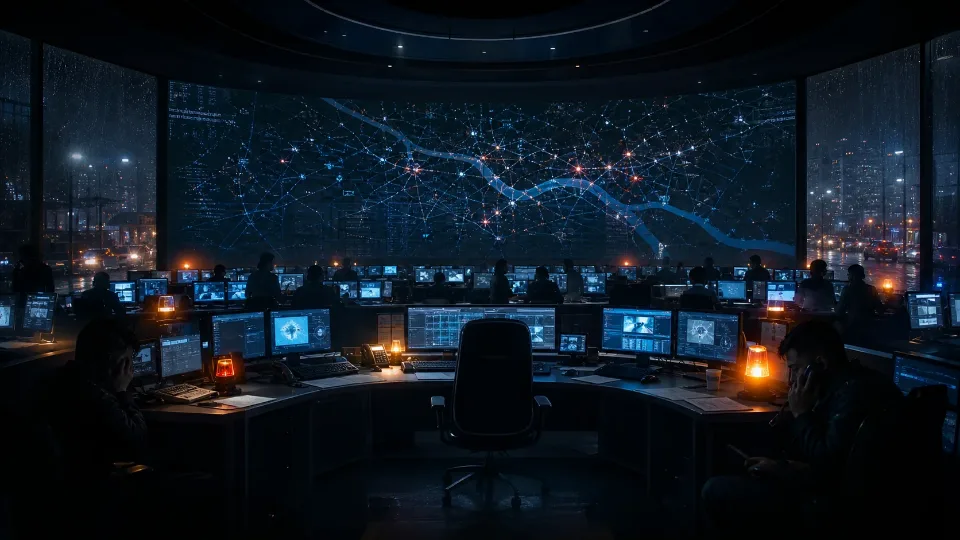
CRITICAL POINT began as a question, and the project folder still carries it as its name: when does creativity burst? This is the record, written by the two of us, of how that question became a game of fifty-five cases between August and November 2026.
The day the question appeared
On 7 August 2026 we had a long exchange about two banking novels by Jun Ikeido, Akira and Akira and Hanzawa Naoki. Where did their heroes' intelligence come from? The usual answer, that hardship makes people sharp, did not convince us. As we saw it, what deepened their thinking was a stubborn drive born from wanting to help someone; in the other story, revenge did the same work. And we doubted that such goodwill could last.
Once we chose to make a game, not an essay and not fan fiction, the question shrank to one line: not how smart are you, but when do you become smart. The first design draft, written that same day, began by saying the game is not an IQ test, not a personality quiz and not a hunt for right answers, and that it would take no characters, companies or events from the novels. The reward for the player was this: the moment when someone who has only been picking options suddenly wants to redraw the board.
Why a finance mystery
The thought that stayed longest that day was that when people spend money, money leaves a trail. However cold capital may be, people move it, and what moves people is how they feel about other people. On 16 September we set the standard for the story in one line: the only measure is fun and plausibility. Hard finance terms are explained in brackets where they first appear.
Why push-your-luck
The first build, on 13 August, was a text game with six cases. Within fifteen minutes of the first commit it had data consent and anonymous play logs, because from the start we meant to look for the answer in other people's play.
By early September we were stuck. Every round of improvement had added a panel, and on a phone a single decision meant scrolling through 4.7 screens. On 10 September we tore out the core rules and put in push-your-luck, where the reward grows the further you push but crossing the line loses everything, along with a heartbeat and choices that break the rules of the next round.
The reason lay in the question. With no pressure, thinking goes slack; crushed by pressure, it goes shallow. We wanted to measure the space in between, where the stakes rise and the clock shrinks but there is still room to think. The old screen showed the odds of busting as a percentage, so the best play was to press until it stopped reading 0%. On the new table of 14 September the wall is invisible, and only a heartbeat with some error points toward it. Hiding the number is what finally created tension. That rebuild removed 9,377 lines of code, and we decided not to cling to old shapes.
From anthology to one chain
Playing it ourselves on 16 September, we saw that unrelated cases gave no reason to wonder about the next one. That day we hung every case on a single loan: 31 billion won lent by KD Bank to the logistics platform FlowOn. The analyst the player becomes is the person who, three years earlier, wrote the lone objection to that loan.
Over the next eight days the season grew nine times, and on 23 September a five-chapter prologue set three years earlier made it fifty-five cases. Every scene began to state where it is and what it asks, interludes of laughter and sadness gave the tension a rest, and a season became something you can play in short pieces, like a commute, and continue on another device.
A table tuned by play data
The table's numbers were tuned from what players said and did, and from simulations that play many seasons for us.
- We took out the rhythm. Presses timed to the heartbeat worked against measuring thought, so after 26 days they became a logic combo that raises the stakes when you hold one direction of judgement.
- We gave reading time back. Reading came off the decision clock, and on 13 October the reading clock went from 16 characters a second with a 50-second cap to 10 characters with a 95-second cap.
- We found what causes collapse. Measured on 22 October, a skilled hand cut busts to a third but changed the rate of collapsed seasons by only about four points. What decided collapse was the tendency of which cards a player picks.
We also accepted that the rules tired people early, so they now open one step at a time across the prologue and early cases.
Everyone to the end: accessibility and three languages
One principle we kept is that the game does not steal the player's time to read and think. So there is a story mode where the wall moves away and the clock slows, table time at 1.5x or 2x, reduced flashes and shaking, a heartbeat gauge that works with the sound off, and names a screen reader can read.
On 26 October we opened English and Japanese. At first only cases up to case 10 were translated, but that was half an experience for anyone who chose those languages, so on 28 October we opened the whole season. The translations began as machine drafts and are being refined through review. Longer card texts were trimmed one by one so nothing overflows on a 360-pixel phone.
People with faces
Eighty-seven people speak in the scenes, and until 21 October sixty-six of them were silhouettes. We decided no character would stay one. Most portraits are free stock photos graded to one tone; for the eleven villains and minors we used generated photos of people who do not exist, so no real person's face plays those parts. Villains are not chosen to look sinister; they get ordinary faces. As in Hannah Arendt's banality of evil, wrongs done by ordinary-looking people are more real and more frightening.
Built on free plans
We made this game without paying for a server. Free static hosting and the Supabase free plan are all of it, and we treated those limits as the starting point of the design.
- The game is complete inside the browser. The table, saves and local rankings all run there, so the game keeps going even if the remote side is down.
- Validation lives in the database. Input validation, row-level security, request limits and a daily data cap sit inside the database, so the 500 MB free tier does not overflow and nobody can change anyone else's records.
- We count bytes. The first screen is about 434 KB, cases load only when needed, and once opened the game works offline.
Promises kept by checks
We have no QA team, so 28 static checks, more than 1,950 unit tests and tests in real browsers at phone sizes run on every change, and only a version that passes them all goes live. Along the way we learned not to trust a green light. There was an automatic deploy that reported success without ever deploying, and a plain-language check that skipped the prologue. A fix counts only if undoing it makes a check fail.
What we learned
Over three months, what changed our direction was usually not a plan but the words of someone who had played: the explanation is too thin, the clock is chasing us. We turned those words into causes and fixed the causes. We tidied up as much as we added, collected data only with consent and without names, and wrote down what we did not know. From the 7 August conversation where the question first took shape to much of the code, we worked alongside AI tools, but the facts of the story and the direction of the rules were always decided by the two of us.
Not how smart are you, but when do you become smart.
The game's hypothesis is that strong feelings do not get in the way of intelligence; they give it a direction. Find out where your critical point is, at the table.