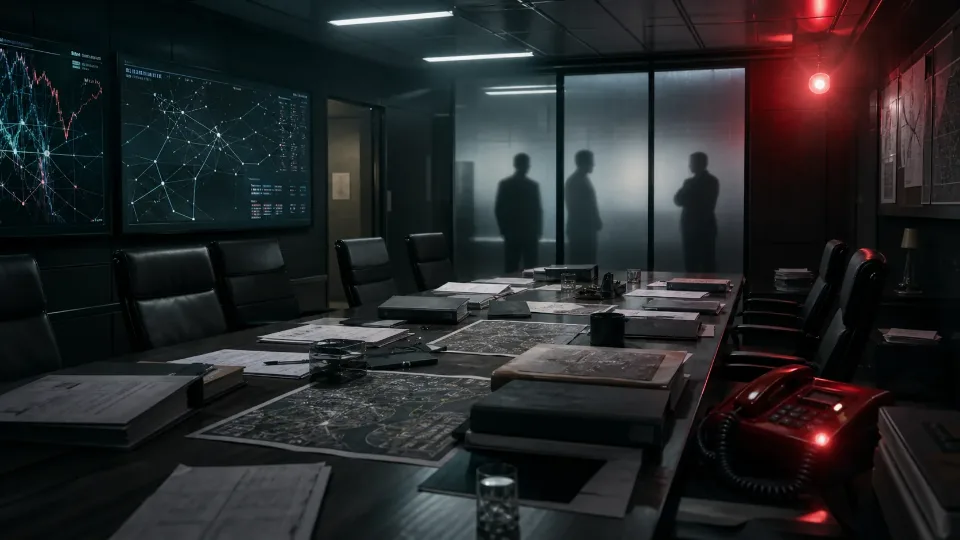
CRITICAL POINT is a choice-driven drama that starts with a single loan at one bank and spreads into the days of many people. This page gathers the characters you will meet again and again, described as each of them first appears.
For each person you will find their role, what they do as the story opens, how they talk and what they want. Nothing here comes from later reveals or endings, so it is safe to read before you play.
Everyone in the story is tied to KD Bank, its financial group, or the companies and people who borrowed from it. The question the story asks is less who is right than who has to pay for saying the right thing out loud.
The people of Trigger Lab
You
The protagonist, and the person the player becomes. You first appear in the autumn of 2022 as a trainee on KD Bank's Corporate Finance Strategy Team. The following year you are sent to examine a 31 billion won loan to the logistics platform FlowOn, loan number 2023-0412, and you are the only one who writes a dissent.
Afterwards you are moved to Trigger Lab, on the fourth floor of an old computer center in Hapjeong-dong that everyone calls the basement. In 2025, when a case file with that loan number lands on your desk again, you make the calls between your colleagues' pressure and ECHO's objections. You have no fixed name or face. Your choices are your character.

Han Seoyun
The director who runs Trigger Lab. She wears her hair tied back short and her shirt sleeves folded up, and her tablet, which never sleeps, always has an old credit report open. Three years ago, as a manager on the strategy team, she was the one who returned your dissent at the team review stage. When she joins the same lab the following spring, she does not hide that loan number.
Her job is to press your decisions against real-world conditions. She asks what is possible before what sounds good, and with her feelings held down she leaves only what can be done and the losses that can be carried. Before answering she scrolls the cash-flow table down one row, and that silence can weigh more than words.
“Let's first see if it's possible. Whether it sounds good comes after.”
Ban Jaewook
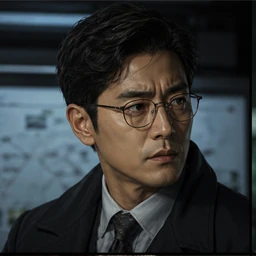
An investigator in seventeen years of service with the group's audit team. Square glasses, a black notebook with a worn cover and a pen that moves before he speaks are his signs. From your trainee days on, he appears as the man who will not wave off a document with an empty approver's signature box, or a number that stops just under a threshold, as a coincidence.
Before he trusts anyone's good intentions he checks the grounds and the order of approval. Who knew what, and when, and under whose name it was signed, is the skeleton of every case for him. He always stands on the side that asks why and who, and he aims those questions at your judgment as hard as at the company's.
“Can you explain the grounds for that call in the same order 3 years from now, at an audit hearing?”

Do Yoonha
Trigger Lab's field officer. Back at window 4 of KD Bank's Gangseo branch he sold products handed down from head office with a three-minute script, and most of the customers were neighbors whose names he knew. Now he wears his ID badge over a field jacket, carries a well-worn radio and runs from site to site.
When numbers fly around the meeting room, he drags the people behind them onto the screen. He is the first to ask whose day the cost of a decision lands on, and if the answer is abstract he puts a real face and name in front of you. Protection and empathy are his measure, but his kindness is never soft.
“Then what do we tell the first person this decision hits? I know that person's face.”
Oh Jinwoo
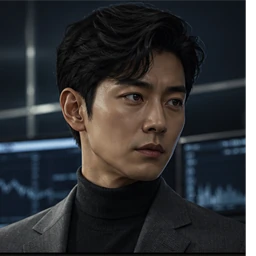
When you were a trainee he was the assistant manager on the strategy team and your mentor. Now he is an analyst seconded from head office to Trigger Lab, and given the same files he puts a faster alternative on the table before you do. A jacket without a crease, a pen squared to the monitor and a second option that is always already drafted describe him well.
His language is speed and winning. Hesitation means being late, he says, and here the one who is late is the one who is wrong. As your rival he digs into the gaps in your reasoning and stirs your competitive streak. His sharpness makes you test your conclusions one more time.
“Fine. But at that speed, you're already late. Here, the one who's late is the one who's wrong.”

Lee Minseo
A contract worker in her third year who keeps Trigger Lab's data and access logs. She believes records must be exact, yet she also knows that, as a contract worker, she is the first to be suspected when a record goes wrong. Early in the story, when an important bank file is said to have leaked, the access log points to her name.
Rather than defend herself, she first asks why the record was put together the way it was. Everyone asks who talked, she says, but nobody asks who made sure someone could not talk. She speaks quietly, winding her lanyard around a finger, but no one feels the distance between a record and a person more sharply than she does.
“If the record points to me, am I already finished?”

ECHO
The verification system that lives inside Trigger Lab's terminals. ECHO appears as a thin waveform on a black screen and a cost display that blinks without emotion, and it builds its objections from thirty years of credit review records. On your first day in the lab, it was ECHO that asked the first question.
ECHO never gives you the answer. Instead it quietly highlights the assumptions left unspoken, the hidden victims and the cost sitting on the other side of the choice you just made. In the game ECHO is the opponent that tests your first judgment, and a voice that will not make the call for you. There is no emotion on its screen, yet one highlighted number can sound sharper than anyone's words.
“Recalculate the people left out of that judgment.”
KD Bank and the group
Yoon Sanghyuk
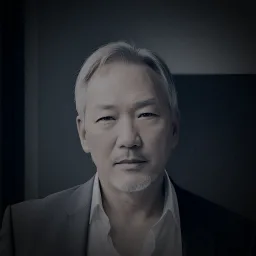
The head of the strategy team when you were a trainee, and later a managing director in KD Financial Group's Group Strategy Office. He wears a plain navy suit and smiles only when shaking hands. At your trainee review he acknowledges the number you found, while telling you that where such a number goes is decided elsewhere.
He does not raise his voice or scold. He speaks in terms of organization, placement and results, and regards deciding where people and work belong as his job. He closes his tablet cover to end a conversation, and the speed at which he closes it is his answer. His view is one axis of the story, showing the logic by which a large organization moves.
“I never said your judgment was wrong. I just decide where that judgment gets to stand.”
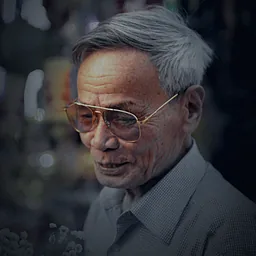
Lim Kyungsoo
In the prologue he is head of KD Bank's Corporate Credit Review Team, a man who files every printout in a binder. By the story's present he has been out of the bank for two years, wearing a cardigan worn through at the elbows and keeping bundles of clipped printouts and pencil notes that never made it into the system.
He does not lecture. Instead he brings out an old case and lets it show you the shape of the current one. He is one of the few who know where an erased record originally lived, and before answering he takes off his glasses and polishes them slowly. Here, finding is far easier than keeping: that is the first lesson he gives a young analyst.
“That report had a back page. All you saw was the front.”

Na Junhyuk
The manager of the Yeongdong branch on Gangwon's east coast, who has spent thirty years working only in branches. He wears a hand-knitted vest instead of a tie, carries a leather pouch with three seals in it. When the story leaves Seoul for a seaside branch, you look with him into accounts and people head office has forgotten.
Faced with an awkward question, he makes one more cup of instant coffee first. He opens with a joke and sets down what he really means where the joke ends. Complaints about head office and long resignation are part of him, but in the quiet branch at three in the afternoon his eye for something odd is still very much awake.
“It gets quiet here by three in the afternoon. In a quiet place, you hear strange things clearly.”

Baek Arin
A deputy manager in the Group Strategy Office and secretary of the group's newly formed Innovation Committee. She wears an unwrinkled gray suit and carries three highlighters of different colors and a tablet always charged to 80 percent. When the group prepares a new campaign to turn public opinion, she comes to ask you, the one who wrote the dissent, to be its face.
She speaks fast, precisely and kindly, gives the numbers first and expresses feelings in percentages. Her craft is to leave the facts unchanged and change the order in which they are told. She knows the power of a story better than anyone and makes no secret of working with it.
“A good story lasts longer than the facts.”

Priya Nair
The person in charge of bringing in NOAH, a new AI credit engine, at KD Data Lab, the group's data unit. She was hired from a Singapore fintech firm and is in her third year in Seoul. She wears a label printer's strap around her neck and carries a sticker-covered laptop and a silver thermos everywhere. She cannot leave anything unnamed, so before she answers she prints a label and looks for somewhere to put it.
She talks fast and brightly, lowering her voice only when she admits she does not know something. She truly cares about the model she works with, yet holds firmly to one rule: she does not trust a judgment that cannot be explained. Approaching the Trigger Lab team as her seniors, she brings into the lab a question about where technology and human judgment meet.
“I don't trust a model that can't explain itself either. That's why this one hurts more.”

NOAH
An AI credit engine from KD Data Lab. NOAH is a server rack with blue light running through it and a small input box in the corner of a work window. It decides in under a second, and before a question is even finished it lays out its grounds and their weights on the screen. Across the bank's work, NOAH's scores begin to sit beside human decisions.
NOAH does not hesitate. It answers in numbers without emotion, and when asked why it decided something it explains that it was trained that way. Unlike ECHO, which raises objections, NOAH puts the conclusion first, and it says what it learned from only when someone asks. That difference shows what a bank stops asking when it hands judgment to a machine.
“I didn't make that standard. That is how I was trained.”
FlowOn and the warehouse floor
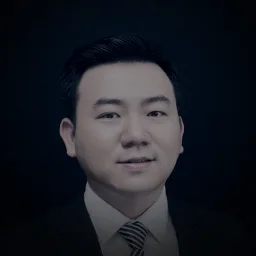
Kwon Dohyun
A credit officer at Bridge Bank who reviews the restructuring of struggling companies, and the eldest son of Kwon Taeho, who founded the logistics platform FlowOn. A gray suit gone shiny at the sleeves and an old ballpoint with his father's company logo make up his look. When FlowOn stands at the edge again, he takes a seat at the negotiating table.
He accepts every offer of help only once it is turned into an income statement. Before he speaks he draws a vertical line down a blank sheet, writing what is gained on the left and what is lost on the right. He looks cold, but his table leaves out none of the staff still at the company or the suppliers waiting to be paid.
“If you want to help, say it with a bill. Sympathy has no column in my books.”

Kang Taemin
The night-shift foreman at FlowOn's fulfillment center, hired in the year the company opened. He wears a high-visibility vest and always keeps two cup noodles in his pocket. You first meet him in the warehouse before dawn during the 2023 review, and he asks you, the person from the bank, what will happen to the promise of permanent jobs his contract coworkers have waited two years for.
He speaks briefly and keeps his word. He speaks for the days of people that no number accounts for, and thinks first of the names of coworkers at the conveyor at four in the morning. By telling you to come back in daylight, he tries to show you another face of the floor.
“I told you to come by day. I said in the daytime this place feels like somewhere people live.”
People from outside
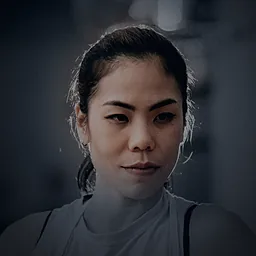
Moon Gaeul
She runs a rice cake shop in Mangwon Market. She first appears in 2023 at the gate of the small factory her husband runs, handing over boxes of rice cakes and saying that people like them do not know much, so if the bank says it works, they believe it. Later she stands before you again as head of a group of people who borrowed at the bank's counters.
An apron she never takes off and a bandage on a finger cut by her rice cake knife are her look. She talks at market speed, and the angrier she gets, the more precise her politeness becomes. Instead of thanks she asks why nobody stopped it, and she turns a list of numbers back into faces, shops and names.
“If you came to hear thank you, you came to the wrong place. Go steam some rice cakes.”

Moon Hajun
Moon Gaeul's son, in his second year of high school. He always has a sketchbook with worn corners under his arm, and when he does not know an answer he opens it and starts drawing. Over the winter break he pins an intern badge to his school uniform and works as a youth finance intern at KD Bank's Gangseo branch.
With the eyes of someone learning for the first time how a bank decides things, he asks straight out about what the bank does not explain. When adults dodge, he asks the same question again. Between drawing a floor plan of the counters and showing older customers to the passbook machine, his simple questions make the experts look again at rules they took for granted.
“You teach how to sell. Don't you teach how not to sell?”

Seo Harin
A reporter in her seventh year at the investigative outlet Leadline. A hoodie with the sleeves pushed up, a highlighter in place of a pen and a phone whose wallpaper is the newsroom cat are her signs. In a small newsroom of eleven reporters and one cat, her job is to drag what happened behind closed doors into a place where everyone can see it.
She asks questions fast and dry, lowering her voice only for the last one. She says plainly that she is on nobody's side. What she writes is the side that can be proved, and she also works out who will be exposed as the price when the story runs.
“I'm not writing for your side. I'm writing for the side you can prove.”
All people, companies, institutions and events in the game are fictional. Each profile describes a person only as they first appear.